A civilization can become extraordinarily good at creating value while remaining catastrophically bad at rewarding its creation. It can keep people alive, enlarge human knowledge, prevent disasters, and maintain the systems everyone depends on, yet give the people doing that work little ownership of the future. At the same time, an arrangement that restricts access or transfers its costs to everyone else can accumulate assets, buy competitors, and finance its own expansion.
The problem is deeper than unfair pay. The distribution of ownership helps determine which activities gain the power to reproduce themselves. When financial success is persistently detached from net contribution, civilization finances its own misdirection. That is the case for calling this its greatest failure mode: a failure in the mechanism that selects and scales our other decisions. More intelligence, more technology, and more capital can accelerate the mistake.
The graph civilization needs to confront
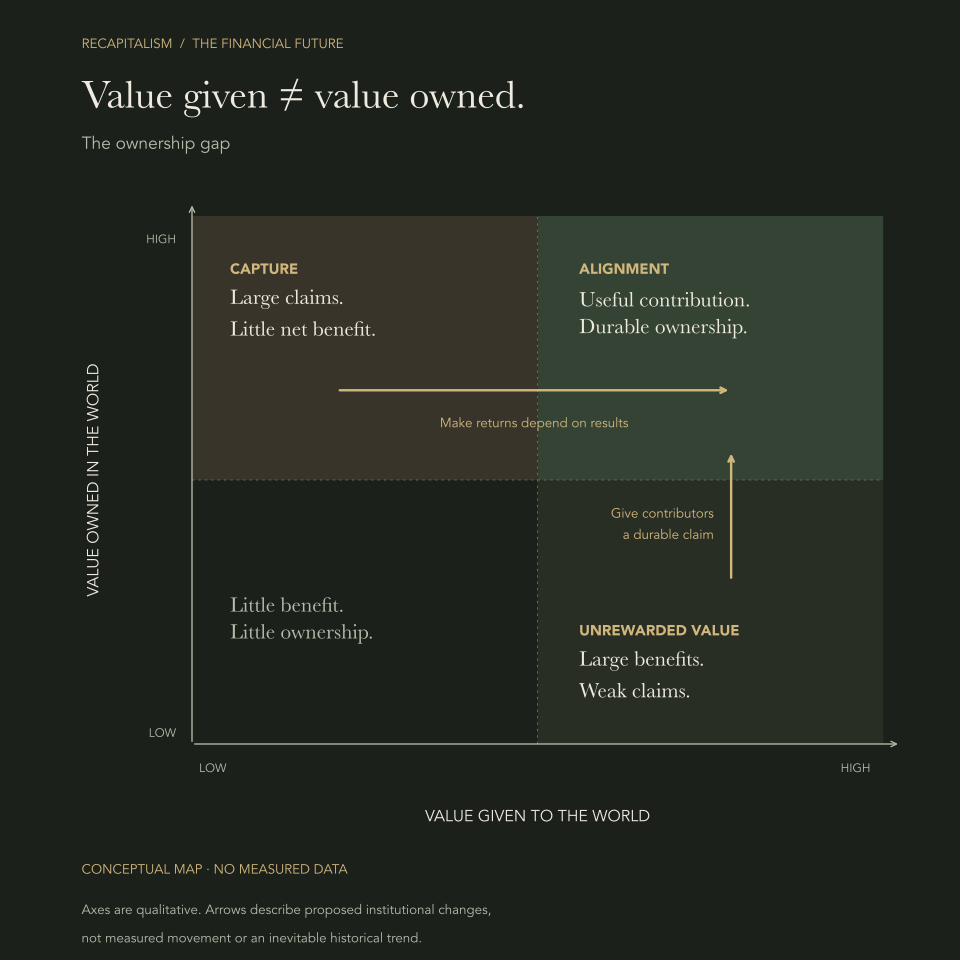
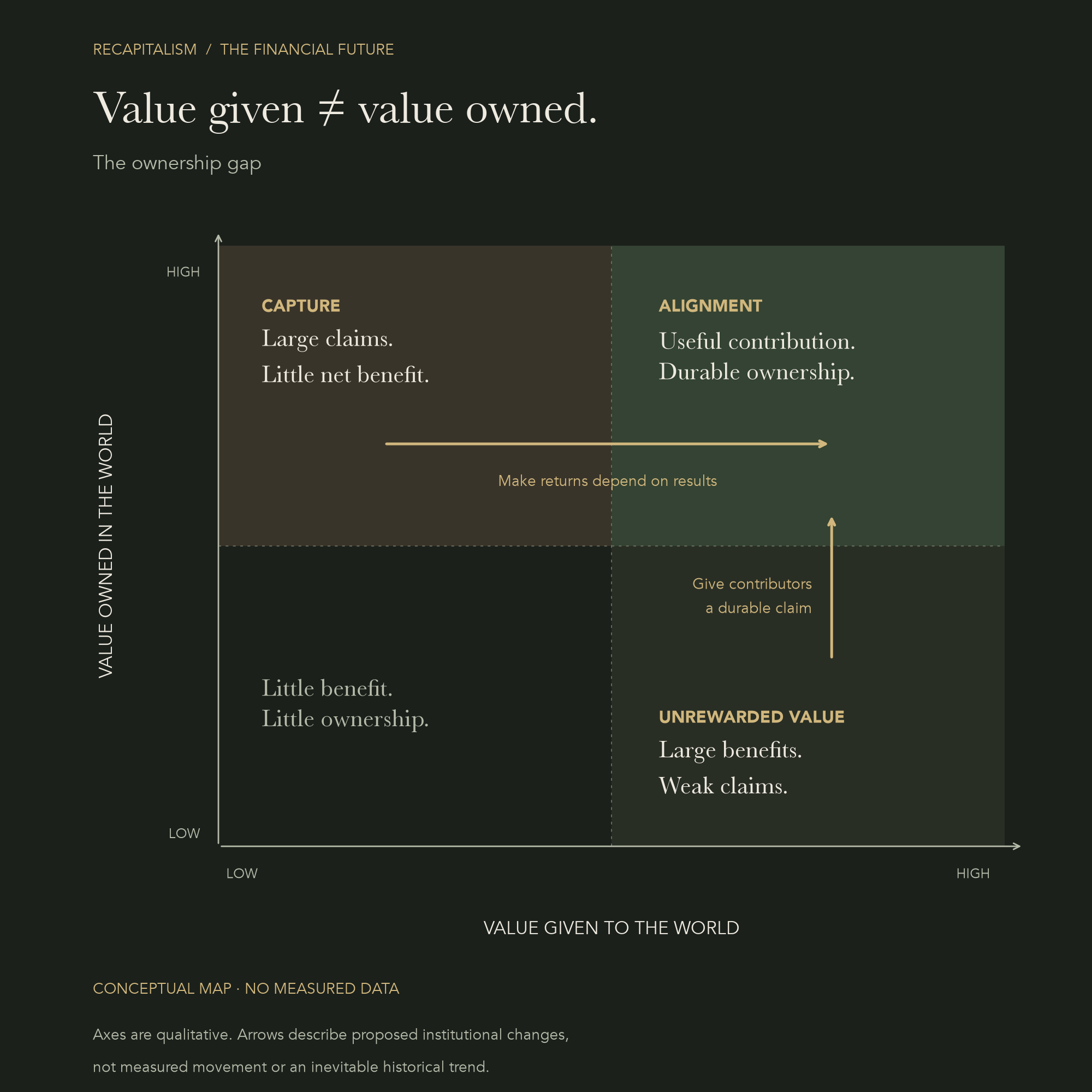
Read the horizontal axis as value given to the world: benefits created, minus harms and resources consumed, compared with what would otherwise have happened. Read the vertical axis as value owned: enforceable claims on assets and future income. These are different concepts. A payment records a transaction; it does not establish that the transaction increased the welfare of everyone it affected.
The graph is a conceptual map, not a measured distribution of people or companies. Ownership is a stock accumulated over time; contribution must be assessed over a stated period and against a counterfactual. The diagram does not assign these concepts a common unit or pretend to measure the distance between them. The arrows show institutional changes we can pursue, not an observed trend or a forecast. Human dignity and access to necessities do not depend on earning a high position on either axis.
Consider the lower right. Knowledge released freely can help thousands of organizations without giving its originator a claim on their gains. Care can sustain another person's capacity to work without building an asset for the caregiver. Maintenance can prevent an enormous loss while appearing in an account only as an expense. These are ways large benefits can escape the income of the person creating them.
The upper left describes the opposite possibility. Control of an unavoidable bottleneck can support a large claim on other people's production. A business can improve its accounts by shifting damage onto people outside the transaction. Ownership here can rise without a corresponding increase in net benefit. This does not mean all profit is extraction or all large fortunes lack contribution. Productive investment, useful invention, and competent coordination belong on the map too. The failure is that the rules can reward either route without reliably distinguishing them.
Why the gap keeps reproducing itself
Start with what an investor can receive. A project may generate enormous social benefits, but unless some of those benefits become collectible revenue, they cannot service a loan or pay a dividend. Another project may generate smaller total benefits but hold a strong contractual right to collect. Under otherwise similar risk and cost, the second can attract more private capital. The investor need not be malicious. The claim is doing the selecting.
The same logic applies to harm. If a decision-maker can retain the revenue while someone else bears part of the cost, the private return overstates the social gain. If a creator cannot collect for benefits enjoyed by others, the private return understates the gain. These are the two directions of the externality problem described in the IMF's explanation of costs and benefits missing from prices .
Now repeat the selection. Retained earnings can finance more capacity, stronger bargaining power, and purchases of additional claims. Where concentrated ownership also protects barriers to entry, an initially favorable position can become harder to challenge. Meanwhile, beneficial activities without adequate revenue must repeatedly appeal for subsidy, volunteer labor, or sacrifice. Their usefulness does not pay their operating bills.
This is why charity after accumulation cannot, by itself, repair the allocation mechanism. It may do essential work. But distributing a fraction of the proceeds later does not change what the system paid people to do earlier. The decisive intervention is upstream: change how useful activity earns, how damaging activity pays, and who keeps a claim when the value compounds.
What actually forces a long-run correction
There is no historical interest rate at which justice automatically compounds. A population can remain excluded for generations; a depleted ecosystem need not recover on a schedule convenient to investors. What cannot continue indefinitely is the repeated destruction of the conditions on which continued production depends. If a system consumes an essential stock faster than it can be replaced, it eventually changes its behavior, finds a substitute, or loses the capacity that stock supported. Adjustment is unavoidable under that premise. An equitable adjustment has to be built.
The constructive route begins where the ownership gap creates a constituency for a better arrangement. People paying avoidable costs have a reason to coordinate. Contributors whose benefits are captured elsewhere have a reason to retain rights. Customers facing a costly bottleneck have a reason to finance an alternative. Those interests are potential demand for institutional change. They become effective only when organization, finance, and enforceable agreements overcome the costs of acting together.
The first mechanism is turning dispersed benefits into a paying customer. A group of building owners can contract for energy savings; customers can commit purchases before a useful supplier expands; beneficiaries can jointly fund shared infrastructure. A benefit that nobody could collect individually becomes revenue under an agreement. Verification and collection still cost money, so start where benefits are observable and the beneficiaries can actually pay. The U.S. Department of Energy's account of energy savings performance contracts describes an existing structure using energy savings to support project financing. The broader design principle is to finance a benefit through the people who receive it.
The second is letting contribution build ownership. Wages compensate current work; a durable ownership claim can also participate in future gains. Worker ownership, community asset ownership, and shared savings agreements change who receives the residual after costs and financing. They differ substantially in governance and risk. The useful test is concrete: who receives distributions, who can change the rules, and what happens when the enterprise is sold? Our guides on shared assets and profit sharing work through those choices.
The third is removing the advantage of exporting costs. Enforceable liability, standards, and charges can make some privately profitable damage less profitable; prohibitions are appropriate where paying a fee cannot make the harm acceptable. Competition and viable exit can weaken a bottleneck's ability to demand payment unrelated to improved service. These mechanisms require political organization and capable institutions. Technology can lower the cost of an alternative, but technology can also strengthen incumbent control. A cheaper tool is an opening, not a settlement.
Together, these changes can create a reinforcing process. A better arrangement gains participants; participants gain income or savings; some of that surplus finances replication and protects their rights. Over time, the aligned sector can acquire its own capital, operating expertise, customer relationships, and political constituency. That is how correction can become cumulative. It will not happen merely because a moral argument has existed long enough.
Apathy about impact investing is surrender
It is easy to ridicule a financial industry that learns the language of impact faster than it changes its contracts. It is harder, and more useful, to distinguish a cosmetic claim from an investment that makes a better outcome possible. If the response to weak impact claims is to abandon the field, the existing allocation system keeps the money and loses even the demand to justify its effects.
Impact investing names a necessary problem: how to direct investable capital toward benefits that matter while establishing a credible financial return. The GIIN's core characteristics call for intentional benefit, evidence in investment design, management of impact performance, and shared learning. Those are practices to demand and improve. A label on a fund does not demonstrate that they happened.
Two questions should survive every presentation. Did the enterprise produce a better outcome than the credible alternative, after accounting for its harms? And what did this investor's capital or involvement change? Buying an already traded share does not, by that act alone, establish that a new useful project was funded. An investor might contribute through a new financing round, terms unavailable elsewhere, governance, or engagement—but the contribution requires its own explanation.
Some projects cannot support a commercial return even when their social benefits are immense. They need public provision, grants, cross-subsidy, or other collective funding. Pretending otherwise encourages the easy-to-monetize benefits to crowd out the indispensable ones. Serious impact investing identifies the portion that can sustain investment and states who funds the rest. It does not demand that every human need first become an attractive asset class.
Pierce the financial system at the point of repayment
The old financial system does not need to accept an entire philosophy before it can finance one aligned enterprise. It needs a transaction it can underwrite: a credible buyer, identifiable cash flow, manageable risk, and enforceable repayment terms. The opportunity is to use those familiar instruments while changing who owns the asset and who receives the surplus.
Employee ownership is a concrete example. The U.S. Department of Labor's report on employee ownership describes financing through banks, community development financial institutions, and sellers who accept payment over time. Existing financial instruments can therefore support a change in ownership. The institution providing the loan need not become the permanent owner of the upside.
Consider an invented acquisition, simplified to expose the mechanism. A worker-owned entity buys a viable business for $1 million, financed with $200,000 of member equity, a $600,000 bank loan, and a $200,000 seller loan. Assume transaction costs and initial working capital are funded separately. The purchase financing totals $1 million; nothing has been created by renaming the debt.
Assume annual cash available after wages, operating expenses, taxes, and maintenance investment is $180,000. Suppose the combined loans require $120,000 that year in principal and interest. That leaves $60,000: allocate $30,000 to reserves and $30,000 to worker-owner distributions. Cash available for debt service is 1.5 times the required payment. The lender is paid through operating cash flow; the workers retain the equity claim and, subject to the governing agreements, the control it carries.
Now stress the case. If that available cash falls to $120,000, debt service consumes all of it and there is nothing left for that year's planned reserves or distributions. At $90,000, the shortfall against scheduled debt service is $30,000, requiring existing reserves, revised terms, new funding, or default. The example assumes a debt-service schedule; it does not establish a market interest rate or a feasible purchase price. Workers also face the concentration risk of tying employment and invested savings to the same business. An aligned purpose cannot repair an overleveraged transaction.
The $200,000 entry requirement presents another real constraint. Workers without savings cannot be wished into ownership. A different structure might use patient outside capital, a funded employee trust, or a larger seller contribution, with the effects on control, price, and risk made explicit. Where concessional support is justified, its cost belongs in the account. IFC's blended-finance principles emphasize additionality and using no more concessional support than necessary to enable the investment. Public or philanthropic support should purchase a demonstrable public benefit, not quietly erase private investors' downside.
The breakthrough here is modest in vocabulary and substantial in consequence: finance the transfer of a productive asset, repay the financiers, and keep the durable claim with its contributors. Repeat the transaction where the economics work. Standardize documents, publish operating results and failures, improve underwriting, and reduce the cost of the next deal. Each successful repetition can make the next ownership transfer more familiar to capital that previously ignored it.
Build a financial future that can defend itself
An aligned enterprise can still sell itself back into the old pattern. Early investors may demand an exit that removes contributor rights. A manager may inflate reported outcomes. A cooperative may benefit members while exporting costs to everyone else. Alignment therefore needs more than a founding intention: beneficiary representation, usable information, independent checks where warranted, and rules governing distributions, sale, and changes of purpose.
The practical starting point is one recurring problem, one identifiable beneficiary group, and one financing structure whose payments can be explained without mythology. Establish the baseline. Secure the customer agreement. State the full costs and downside. Give contributors enforceable rights before their dependence grows. Show what the capital changes. Then earn the right to repeat it. The shared savings mechanism illustrates another entry point; the transition essay examines how a better deal acquires the power to survive.
The ownership gap will not close because investors become embarrassed by a graph. It can close when the people creating and sustaining value gain the ability to finance, own, and defend its production—and when retaining the proceeds of harm becomes harder than earning through useful contribution.
We cannot afford apathy about impact investing. We cannot afford to confuse a fund's vocabulary with a changed economic structure, either. The task is to bring the aligned financial system forward transaction by transaction, with enough rigor to survive and enough ambition to change what survival rewards. A civilization should not have to impoverish its contributors to make its owners rich. Build the claims that make giving value a source of lasting power.
The conclusion
The ownership gap closes when useful contribution can finance itself, contributors retain enforceable claims, and exporting harm loses its financial advantage. Build those arrangements through the capital and contracts available now.